

Trump Accounts 101: Everything You Need to Know

Trump Accounts: What Parents Need to Know
Created under the 2025 tax law, Trump Accounts (TAs) give every eligible child a tax-deferred investment account, and some children qualify for a free government deposit. If you have children or grandchildren under 18, or know a family who does, here's our summary, with more details below:
Prioritizing education? Consider a 529 first. 529 plans offer tax-free withdrawals for education, state tax deductions in many states, and a tax-free rollover of up to $35,000 to a Roth IRA.
Claim the Trump account, even if you don't plan to fund it. Every eligible child now has an account, and claiming it protects against identity theft and makes sure you see any free deposits. If your child was born 2025–2028, also elect the free $1,000 government deposit. Beyond that, think of a Trump Account as an early start on your child's retirement savings: the money is locked until the year your child turns 18, when traditional IRA tax rules apply.
Plan the Roth conversion. If funding the Trump Account, converting it to a Roth IRA during your child's low-income years can lock in tax-free growth for life, as long as the timing works around the kiddie tax.
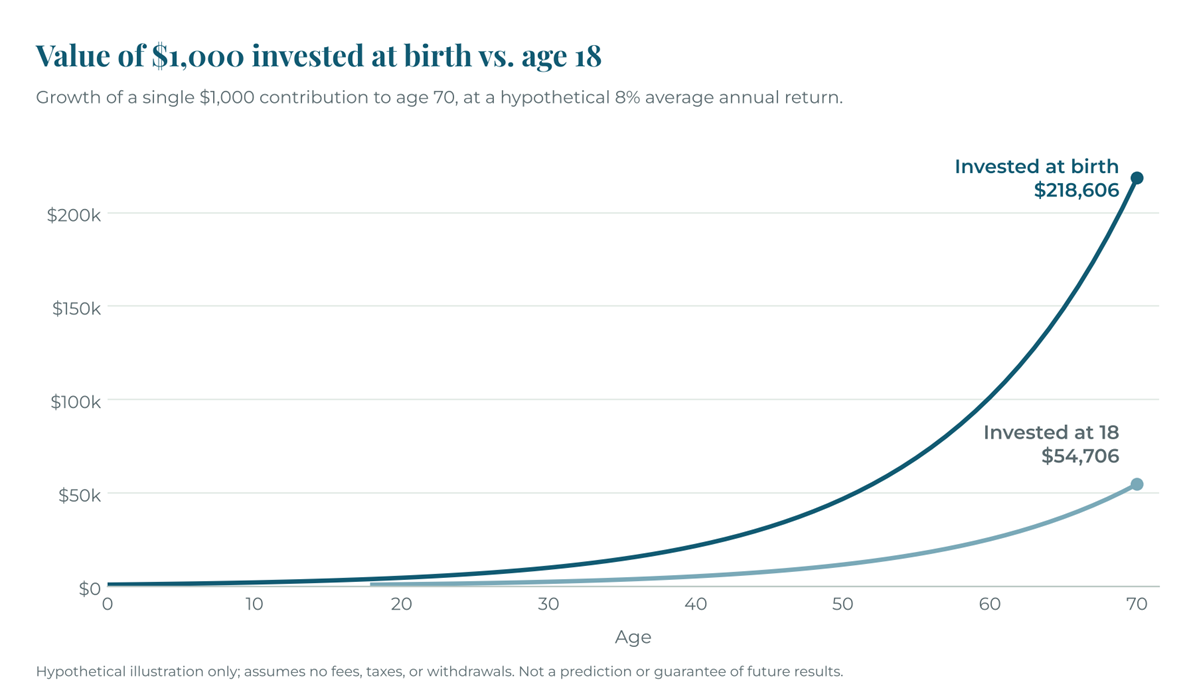
Why starting early matters: $1,000 at birth vs. age 18
Time is the biggest advantage here: at a hypothetical 8% average annual return, $1,000 invested for a newborn grows to about $218,600 by age 70. The same $1,000 invested at age 18 grows to about $54,700. Larger or ongoing contributions widen the gap even further.
Getting started: claim your child's account
In October 2026, the Treasury Department automatically opened a Trump Account for every eligible child under 18 with a valid Social Security number, but each account must be claimed before it can be used.
There's no way to opt out of or close the account, and no deadline to claim it. Still, we recommend claiming it, even if you never plan to contribute, so that you, not someone else, control your child's account.
Claim the account through the official Trump Accounts app or the web portal at trumpaccounts.gov. You'll verify your identity and your relationship to the child.
Why claim an account you won't fund? An unclaimed account is an open door for misuse. For example, if your child's Social Security number has been exposed in a data breach, a fraudster could try to claim the account in your place, then redirect any charitable deposits or later access the funds. Timing also matters for separated parents: if both are eligible, the first to complete the claim controls the account.
Children born 2025–2028: The $1,000 government deposit is not automatic, even though the account was opened for you. After claiming the account, you must also elect the deposit on IRS Form 4547 (available in the app or through your IRS online account).
Contribution limits
Parents, grandparents, friends, and employers can contribute a combined $5,000 per year until the year the child turns 18.
Employers can contribute up to $2,500 of that tax-free.
Government and charitable deposits don't count toward the $5,000 limit.
How the money is invested
Contributions from family, employers, and the government are invested in low-cost U.S. stock index funds with fees of 0.10% or less. Under new rules, charitable donors can also contribute individual stocks, which must be held for at least five years. The money grows tax-deferred, with no taxes on growth until it's withdrawn.
Withdrawals and taxes
Before age 18 (the “growth period”): no withdrawals allowed. The only exceptions are moving the money to another Trump Account, rolling it into an ABLE account for a child with a disability, or correcting an over-contribution. The growth period ends January 1 of the year your child turns 18, not on the birthday itself.
From age 18 on, the account follows traditional IRA rules. Your child can withdraw for any reason, but how each dollar is taxed depends on where it came from:
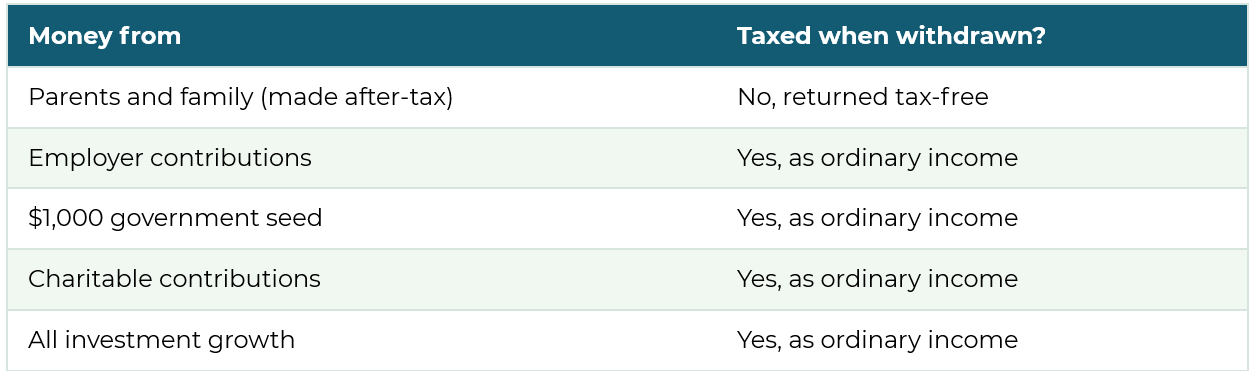
Withdrawals are proportional. You can't take out the tax-free family money first. If 25% of the account is family contributions, every dollar withdrawn is 25% tax-free and 75% taxable.
A 10% early withdrawal penalty applies before age 59½ unless an IRA exception applies. Common exceptions include qualified higher-education expenses, a first-time home purchase ($10,000 lifetime), and birth or adoption costs.
Keeping good records
Track your after-tax contributions. Family contributions are made with after-tax dollars (basis), which is what makes them tax-free when withdrawn years from now. The account's trustee should report contributions and the after-tax amount each year, but we recommend you keep your own records too, especially if you ever move the account. Verify with your tax advisor, but your child may need to file Form 8606 with their tax return to track after-tax basis.
Gift tax: Family contributions count as gifts to the child. At $5,000 a year they're well within the annual gift tax exclusion ($19,000 per giver, per recipient in 2026), but they count toward each giver's total for that child, so coordinate with any 529 or custodial account gifts.
Turning a Trump Account into a Roth IRA
At 18, your child's Trump Account becomes a traditional IRA, and withdrawals will eventually be taxed as ordinary income. Converting it to a Roth IRA while your child's income is low means paying a small tax now in exchange for tax-free growth for life.
However, parents should be aware of the “kiddie tax.” It applies to children under 18, and to young adults age 18 (or full-time students age 19–23) whose earned income doesn't cover more than half of their own support. The IRS uses a three-tier system for a child's unearned income (dividends, interest, capital gains, and the taxable part of a Roth conversion):
First tier (up to $1,350): completely tax-free, covered by the child's standard deduction.
Second tier ($1,351 to $2,700): taxed at the child's own rate (usually the lowest 10% bracket, or 0% for long-term capital gains).
Third tier (anything over $2,700): taxed at the parents' tax rate.
Thresholds are as of 2026. Wages from part-time or summer jobs are earned income and are not subject to the kiddie tax.
Strategies to consider if funding the TA:
Upon reaching age 18, convert just enough each year to keep your child's total unearned income, including the taxable part of the conversion, under $2,700.
In the first low-income year after the kiddie tax no longer applies (for example, age 24 or a year your child isn't a full-time student), convert a larger amount while they're still in the 10–12% brackets.
Pay the tax from other funds if possible, so the full amount stays in the Roth.
A few things to watch:
Other income in your child's name (custodial account dividends, taxable scholarships) counts toward the $2,700 unearned income limit.
Conversions must be done by December 31 each year.
If your family applies for financial aid, conversion income counts on the FAFSA, though small conversions often have little or no impact.
Trump Accounts vs. 529 plans
For education, 529 plans are still hard to beat. Many states (including New Jersey and New York) offer a state tax deduction for contributions, and withdrawals are tax-free for qualified education expenses. A 529 is typically used up within 20–25 years of opening.
Trump Accounts are best viewed as long-term retirement savings, with a time horizon of 50+ years. Both accounts are funded with after-tax dollars, and both can be moved (at least partly) into a Roth IRA, but there's an important difference:
A 529-to-Roth rollover is tax-free, up to a $35,000 lifetime limit. (The 529 must be open at least 15 years, the child needs earned income, and annual Roth contribution limits apply.)
A Trump Account-to-Roth conversion is taxable on everything except family contributions.
So for many families, it makes sense to fund a 529 first, at least enough to take advantage of the full $35,000 tax-free Roth rollover, before adding your own money to a Trump Account.
Sources
Trump Accounts – official portal
U.S. Treasury – Completion of Automatic Enrollment for Trump Accounts (Oct. 1, 2026)
IRS – Topic No. 553, Tax on a Child's Investment and Other Unearned Income (Kiddie Tax)
EY Tax News – IRS Releases First Set of Guidance on Trump Accounts
Disclaimer: The growth figures above are hypothetical, assume an 8% average annual return with no fees, taxes, or withdrawals, and are not a prediction or guarantee of future results. Tax rules are as of October 2026, and some details are still awaiting final IRS regulations. This material is for general informational purposes only and is not individual tax, legal, or investment advice. Please consult your tax advisor regarding your specific situation.